When to reach for a percentage calculator instead of mental math
Drei Rechner in einem: Prozentwert, Anteilsverhältnis und prozentuale Veränderung.
Wie viel sind X% von Y?
15 % von 200
30
Nach +15 %
230
Nach −15 %
170
Wie viel % sind X von Y?
45 ist wie viel % von 180
25.00%
Prozentuale Änderung von X zu Y
Prozentuale Änderung
+25.00%
Anstieg
So verwenden Sie diesen Rechner
- 1 — 1 — Prozent und Zahl: Anteil und Werte nach Zu-/Abnahme.
- 2 — 2 — Zwei Zahlen: welchen Prozentsatz bildet die erste von der zweiten.
- 3 — 3 — Alt- und Neuwert: prozentuale Veränderung.
Percentage calculator formulas, and when each one applies
Three questions get called “percentage” and each takes a different formula. Picking the wrong one is the most common way a percentage goes wrong in a spreadsheet, so it is worth knowing which of the three you are actually asking:
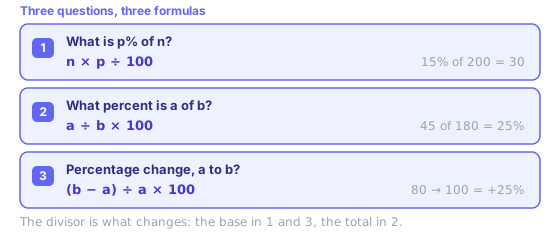
- Section 1 — taking a slice
- A tip, sales tax, a deposit, a commission, progress against a quota. You know the whole and you want part of it.
- Section 2 — comparing two numbers
- A test score, a conversion rate, one line item against a budget. You know both numbers and you want the ratio between them.
- Section 3 — measuring a move
- A price change, headcount, traffic month over month. Whichever value came first is always the divisor, which is what makes the answer directional.
One shortcut worth knowing: to find a percentage of a number, p% of n always equals n% of p. If 18% of 50 looks awkward, flip it — 50% of 18 is 9, and you did it in your head.
Reverse percentage: working back to the original number
This is the calculation people get wrong most often, because instinct says to subtract that same percentage again. You have to divide instead. If a price of £78 is what remains after a 30% increase, the original was 78 ÷ 1.30 = £60 — not 78 − 30%, which would give £54.60. Going the other way, if $90 is a price after 25% off, the original was 90 ÷ 0.75 = $120.
That asymmetry explains a result which looks like a bug. Take 100, add 10% to get 110, then take 10% off: you land on 99, not 100. Your increase was 10% of 100 and your decrease was 10% of 110, so a percentage increase or decrease of the same size is never the same amount. To undo a 10% rise you need a 9.09% cut. Stacked discounts behave this way too — 25% off then a further 20% off is 40% off in total, not 45%, because that second cut applies to an already reduced price.
To reverse anything with this percentage calculator, use section three: put your known figure in as the new value, try an original, and adjust until the percentage change matches what you were told. Or use the discount calculator, which reverses a sale price directly. If the same rate applies period after period rather than once, that is compounding, and the compound interest calculator is the right tool.
Percentage points are not percent change
When a rate moves from 20% to 25%, two different true statements describe it: it rose by 5 percentage points, and it rose by 25%. One is a plain gap between two percentages. The other is relative change, 5 ÷ 20 × 100, and that is what section three of this percentage calculator computes.
This matters whenever whatever is being measured is itself a percentage — interest rates, unemployment, market share, tax bands. “Approval climbed 25%” and “approval climbed 25 points” describe very different weeks. Comparing two percentages? Say points. Measuring growth? Say percent.
Percentage change in Excel and Google Sheets
Same formula, same in both. With the old value in A2 and the new value in B2, percentage change is =(B2-A2)/A2 with the cell formatted as Percentage, or =(B2-A2)/A2*100 if you want a plain number. =B2/A2-1 is the same sum written shorter.
Two things catch people out. A #DIV/0! means the old value is zero, and percentage change from zero is undefined — no formula fixes that, because there is no base to compare against. And if A2 and B2 are already percentages, subtracting them with =B2-A2 gives percentage points, not percent change; the full formula above gives the relative move.
Common percentage calculations
Worked-out pages for frequently searched sums, each with a reference table.
- 10% of 100
- 15% of 100
- 20% of 100
- 25% of 100
- 30% of 100
- 40% of 100
- 5% of 1,000
- 10% of 1,000
- 15% of 1,000
- 20% of 1,000
- 1% of 1,000
- 10% of 50
- 15% of 50
- 20% of 50
- 18% of 50
- 20% of 60
- 15% of 60
- 10% of 200
- 15% of 200
- 20% of 200
- 25% of 200
- 30% of 200
- 20% of 80
- 25% of 80
- 40% of 50
- 7% of 100
- 8% of 100
- 3% of 100,000
- 6% of 50,000
- 2% of 100,000
- 1% of 1,000,000
When to reach for a percentage calculator instead of mental math
Plenty of percentages are quicker in your head than in any tool. Ten per cent is a decimal point moved one place left; 5% is half of that; 20% is a fifth; 25% is a quarter; 1% is two places left. Chain them and you cover most of daily life — 17.5% is 10% plus 5% plus half of that 5%. A percentage calculator earns its place when numbers stop being round, when an answer feeds something else, or when being off by a few per cent actually costs money.
It also earns its place when a question runs backwards. To find a percentage of a number is one multiplication, but recovering an original figure from one that already includes a percentage increase or decrease means dividing, and dividing by 1.3 is not something most people do while standing at a till. Same goes for comparing two percentages measured against different bases — a 40% conversion rate on 20 visitors and a 30% rate on 2,000 are not really a 10-point story.
Where percentages bite hardest is in sequence. Applying a percentage increase or decrease twice does not double it, and reversing one does not use the same figure, because each step is measured against whatever a number happened to be at that moment. Anything involving repeated growth, where a rate applies to last period’s result rather than to one fixed starting number, is a different calculation altogether.
Precision is worth a thought too. This percentage calculator keeps four decimal places on amounts and two on rates — more than enough for a tip, not enough for a contract. Round at the end rather than at each step, or three rounded lines stop adding up to a rounded total. Accountants call that a penny difference, and it is a rounding-order problem rather than a maths error.
In-depth guides
- How Stacked Discounts Really Work: 30% + 20% Is Not 50%
Why successive discounts multiply, how coupon order changes the price, what “buy one get one” is really worth, and how to spot a discount that is not a deal.
- Exchange Rates Explained: Mid-Market Rates, Card Fees and What You Actually Pay
Where reference exchange rates come from, why your bank’s rate is different, how dynamic currency conversion costs you, and how to compare transfers.
Related tools
These free tools pair well with this page — open them in a new tab to finish your workflow.
Häufige Fragen
Wie berechne ich X% von Y?
Multiplizieren Sie Y mit X/100. Beispiel: 15% von 80 = 80 × 0,15 = 12. Umgekehrt: Um den Prozentsatz zu finden, den X von Y ausmacht: (X / Y) × 100. Beispiel: 12 ist welcher Prozentsatz von 80? (12 / 80) × 100 = 15%.
Was ist eine prozentuale Zu-/Abnahme?
Prozentuale Änderung = ((Neuer Wert − Alter Wert) / Alter Wert) × 100. Ein positives Ergebnis ist eine Zunahme; negativ ist eine Abnahme. Beispiel: von 50 auf 65: ((65 − 50) / 50) × 100 = 30% Zunahme.
Wie finde ich den Originalwert vor einer prozentualen Änderung?
Wenn ein Wert nach einer P%-Erhöhung V ist, ist der Original = V / (1 + P/100). Nach einer P%-Senkung: Original = V / (1 − P/100). Beispiel: wenn ein Preis von 78 € nach einer 30%-Erhöhung gilt, war der Original 78 / 1,3 = 60 €.
Was ist der Unterschied zwischen Prozentpunkten und Prozent?
Ein Prozentpunkt ist eine absolute Differenz zwischen zwei Prozentwerten. Wenn der Steuersatz von 20% auf 25% steigt, stieg er um 5 Prozentpunkte (nicht 5%). Die relative prozentuale Änderung wäre (5/20) × 100 = 25%.
Wie addiere ich einen Prozentsatz zu einer Zahl?
Multiplizieren Sie die Zahl mit (1 + Prozentsatz/100). Um 20% zu 150 hinzuzufügen: 150 × 1,20 = 180. Um 20% abzuziehen: 150 × 0,80 = 120.