什麼是 Base64,何時使用?
將文字編碼為 Base64,或將 Base64 字串解碼為純文字,支援 Unicode 和表情符號。
How to encode text to Base64 or decode a Base64 string
- Pick a direction. Encode turns readable text into Base64; Decode turns a Base64 string back into plain text.
- Paste into the top box. The conversion runs on every keystroke, in this tab — there is no upload step and no server round trip, so pasting a token or a customer record is safe.
- Read the result underneath, then hit Copy. If decoding fails, the box stays empty and an error appears; the causes are listed further down this page.
- Use Swap to feed output straight back in as input. Encode, swap, then decode a Base64 string back to plain text and you should get exactly what you started with — a quick way to confirm a clean round trip.
How Base64 encoding works, one block at a time
Take Hi! — three characters. In UTF-8 they are bytes 72, 105 and 33, 24 bits in total. A Base64 encoder ignores those byte boundaries and re-slices all 24 bits into four groups of six:
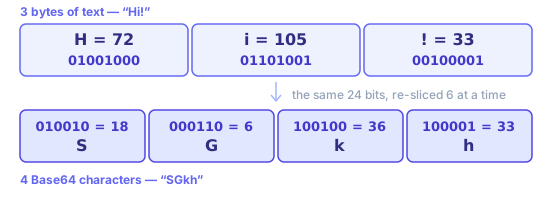
Each 6-bit group is a number from 0 to 63, and each number picks one character out of a 64-character alphabet: 0–25 are A–Z, 26–51 are a–z, 52–61 are 0–9, 62 is + and 63 is /. So 18, 6, 36 and 33 become SGkh. Three bytes in, four characters out, every time.
Padding is what happens when input does not divide by three. Encode Hi — two bytes, 16 bits — and you get SGk=: three real characters and one = to fill out that block. Drop to a single H and it is SA==. Those = characters carry no data; they only keep Base64 output a multiple of four, so a Base64 decoder knows where a final block ends.
Where a Base64 encoder is actually used
Every one of these exists for one reason: a channel in the middle only accepts text.
- Data URIs in CSS and HTML
- A small icon written as data:image/png;base64,iVBORw0… ships inside a stylesheet, so browsers draw it without a second request. Worth doing under a couple of kilobytes; past that, Base64’s 33% overhead costs more than a saved round trip. The image to Base64 converter builds the whole data URI for you.
- Binary fields in JSON APIs
- JSON has no byte type. A signature, a thumbnail or a PDF travels as a Base64 string field, and whatever reads it runs a Base64 decoder to get those bytes back.
- HTTP Basic authentication
- The header is literally Authorization: Basic plus Base64 of "user:password". It is obfuscation, not protection — which is why Basic auth is only safe over HTTPS.
- JWTs and signed tokens
- A JWT’s header and payload are URL-safe Base64. Paste either segment here to read its claims; segment three is a signature and will not decode to readable text. The JWT decoder splits the three segments for you.
- Email attachments (MIME)
- SMTP was built for 7-bit text, so attachments travel Base64-encoded with Content-Transfer-Encoding: base64 and line breaks every 76 characters.
- Secrets in config and CI
- Kubernetes Secrets and many CI variables hold Base64 values so certificates and keys survive YAML. Base64 keeps those bytes intact; it does not keep them private.
Why your Base64 decoder says “Invalid Base64 string”
A string that refuses to decode is almost never corrupt. It is one of these five, roughly in order of how often they come up:
- URL-safe alphabet
- The string contains - and _ where a standard Base64 decoder expects + and /. Swap them back before decoding — JWTs, OAuth state and signed URLs all use this variant. If percent-encoding is what you actually wanted, that is the URL encoder, not Base64.
- Missing padding
- A valid Base64 string is a multiple of four characters long. URL-safe encoders often drop trailing = signs; add one or two back until its length divides by four.
- Line breaks and stray spaces
- MIME wraps output at 76 characters, and copying from a terminal or an email header adds newlines. Strip that whitespace and your Base64 string usually decodes fine.
- It was never text
- A PNG or a PDF decodes to bytes, not to readable characters, so a text-only Base64 decoder shows garbage. That is binary data, not an invalid string — see below for how to decode Base64 to a file.
- Double encoding
- If one decode pass returns something that still looks like Base64 — all letters, digits and a trailing = — it was encoded twice. Press decode again.
When you are not sure which it is, paste your string into both panes. If encode gives you something and decode errors, you are holding plain text, not Base64.
Decoding Base64 to an image, a PDF or any other file
This page handles UTF-8 text in both directions. Files are a different job, because the result has to be saved as bytes rather than shown as characters:
- Images (PNG, JPEG, WebP, SVG)
- The image to Base64 converter goes both ways: drop a file to get a data URI or raw Base64, or paste a Base64 image back and download the picture.
- PDFs and everything else
- The shell is the shortest route, and it works the same on macOS and Linux:
base64 < report.pdf > report.txtto encode, andbase64 -d < report.txt > report.pdfto decode. The bytes never leave your machine either way. - A data URI you were handed
- Everything up to and including the comma in
data:application/pdf;base64,is a MIME prefix, not Base64. Drop it first; what follows the comma is the part a Base64 decoder wants.
什麼是 Base64,何時使用?
Base64 以 64 個可列印 ASCII 字元表示二進位資料。每 3 位元組變成 4 個字元(約增加 33% 大小),方便放在 JSON、郵件或 data URI 中。
常見用途:內嵌小圖、API 二進位欄位、MIME 附件;HTTP Basic 亦用 Base64 編碼帳密。
Base64 不是加密。請勿用來隱藏敏感資訊;請使用真正的加密或雜湊。
Text has to become bytes before any of this happens, and whichever character encoding you pick decides which bytes. This Base64 encoder uses UTF-8, so "你好" becomes six bytes and then "5L2g5aW9", while a party popper emoji 🎉 becomes four bytes and then "8J+OiQ==". If you encode text as UTF-8 and decode it as Latin-1 somewhere downstream, your Base64 round trip was perfect and mojibake came from a mismatched charset, not from Base64 itself.
Base64 is not encryption and not a hash. It has no key, it is perfectly reversible, and any Base64 decoder — including this page — will read it instantly. Never use it to hide an API token, a password or personal data. Reach for real encryption when something must stay secret, or a hash when you only need to compare values. Base64’s one real strength is carrying bytes through a text-only pipe unchanged.
Worked examples
"hello"  → aGVsbG8=
"café"   → Y2Fmw6k=
"你好"    → 5L2g5aW9

Decoding also accepts URL-safe Base64 without padding, as used in JWTs:
eyJhbGciOiJIUzI1NiIsInR5cCI6IkpXVCJ9 → {"alg":"HS256","typ":"JWT"}
Text is converted to UTF-8 bytes before encoding, so accented letters and Chinese characters round-trip exactly. Line breaks and spaces in pasted Base64 are ignored when decoding, and output that is not valid UTF-8 text — for example Base64 of an image or a ZIP file — is reported as an error rather than shown as garbled characters.
In-depth guides
- Base64 and URL Encoding: When to Use Which
Base64 is not encryption. Learn URL-safe variants, where padding matters, and how to avoid double-encoding form fields and API query strings.
Related tools
These free tools pair well with this page — open them in a new tab to finish your workflow.
常見問題
什麼是Base64?
Base64是一種將二進位資料(或文字)轉換為ASCII字串的編碼方案。常用於在只支援文字的場景中傳輸資料,例如電子郵件附件、CSS/HTML中的資料URI或JSON酬載。
Base64會加密我的資料嗎?
不會。Base64是編碼而非加密,任何人都可以輕鬆解碼Base64字串。請勿使用Base64來隱藏敏感資訊——應使用適當的加密演算法。
Base64的大小開銷是多少?
Base64編碼會將資料大小增加約33%。每3個位元組的輸入變成4個Base64字元。在將大型圖片或檔案嵌入為Base64字串時,這是一個重要考量。
什麼是URL安全的Base64?
標準Base64使用+和/字元,這在URL中有特殊含義。URL安全Base64將+替換為-,將/替換為_,使輸出可以安全地包含在查詢字串和路徑參數中,無需百分號編碼。
我可以用這個工具編碼二進位檔案嗎?
此工具對文字(UTF-8)進行編碼和解碼。對於圖片或PDF等二進位檔案,您需要先讀取原始位元組再進行編碼。將二進位資料作為文字貼上可能會產生錯誤結果。
「無效的Base64」是什麼意思?
有效的Base64字串只包含A–Z、a–z、0–9、+、/和=(填充)。如果字串包含其他字元,或者去除填充後長度不是4的倍數,解碼將失敗。
Base64和ASCII編碼相同嗎?
不同。ASCII是將字元映射到位元組值的字元編碼標準,而Base64是一種二進位到文字的編碼方案。兩者並無關聯,儘管Base64的輸出恰好完全由ASCII字元組成。